



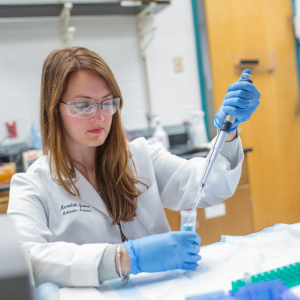


The Liu lab uses in vitro protein selection strategies to address biological problems on a proteome-wide scale. The major tool used in the lab is a novel technique called mRNA display, in which a protein is covalently linked to the 3' end of its own mRNA. Because of this physical link, mRNA display provides a rapid and powerful means of identifying protein-protein interactions by amplifying or enriching for interacting proteins based on functional characteristics. The lab’s research interests can be divided into three major objectives. The first objective is to define enzyme-substrate interactions on a proteome-wide scale. In particular, they are interested in “degradomics,” which aims to define the entire substrate repertoire of various protein-degrading enzymes, including caspases, granzymes, calpains and matrix metalloproteases. The second objective is to decipher the specificity of protein degradation mediated by ubiquitin and ubiquitin-like proteins. These proteins are used to tag specific proteins at specific times for degradation, thereby regulating the levels of these proteins as needed by the cell. In order to understand how the specificity of this degradation is controlled, the Liu lab is identifying motifs on target proteins by mRNA display that are recognized by ubiquitination. The third objective is to establish a systematic method for identifying protein-protein interactions, such that the whole spectrum of interacting proteins can be defined for any protein of interest.

Selected Publications:
Kim JS, Valencia CA, Liu R, Lin W. (2007) Highly-Efficient Purification of Native Polyhistidine-Tagged Proteins by Multivalent NTA-Modified Magnetic Nanoparticles. Bioconjug Chem. 18:333-41.

Shen X, Valencia CA, Szostak JW, Dong B, Liu R. (2005) Scanning the human proteome for calmodulin-binding proteins. Proc Natl Acad Sci USA 102:5969-74.

Baggio R, Burgstaller P, Hale S, Putney A, Lane M, Lipovsek D, Wright M, Roberts R, Liu R, Szostak J, and Wagner R. (2002) Identification of epitope-like consensus motifs using mRNA display. J Mol Recognit 15:126-34.

Cho G*, Keefe A*, Liu R*, Wilson D* and Szostak J. (2000) Constructing high complexity synthetic libraries of long ORFs using in vitro selection. J Mol Biol 297:309-319.
*Contributed equally.

Liu R, Barrick J, Szostak J and Roberts R. (2000) Optimized synthesis of RNA-protein fusions for in vitro protein selection. Meth Enzymol 318:268-293.


contact information:

[phone]
(919) 843-3635

[email]

[website]