



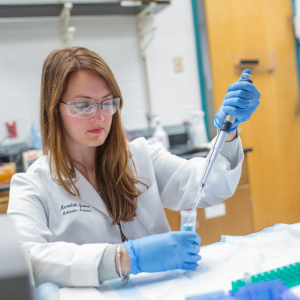


The Threadgill lab uses mouse models to study the complex interactions between genes and the environment that together determine individual differences in susceptibility to common diseases. The lab uses a broad range of genetic and genomic tools to study the following research areas:

(1) Genetic and environmental factors contributing to colon cancer susceptibility.
Colon cancer causes the second largest number of cancer deaths each year. Like humans, mice show different levels of susceptibility to colon cancer. Several different mouse models are used in the lab to characterize genetic and environmental modifiers of cancer susceptibility. The lab is also investigating differences in enteric flora and how they contribute to differences in disease.

(2) Genetic modifiers that influence the phenotype of Egfr null mutants.

Mouse mutants of the epidermal growth factor receptor (Egfr) locus often show phenotypes similar to intrauterine growth retardation (IUGR) in humans. The phenotypic severity of mice completely lacking Egfr is quite variable depending upon genetic differences in the strain background, mirroring variation in severity of IUGR in humans. The Threadgill lab is using this mouse model to study the mechanism behind variation in IUGR severity.

(3) Role of Egfr in normal and cancerous GI biology.
Inhibitors of Egfr are currently in various stages of clinical trials for several types of cancers. The Threadgill Lab has shown that some mouse colon tumors are highly dependent upon Egfr for their initial development. Using these models, the lab is investigating the mechanism of Egfr dependency and the ways by which tumors develop independently of Egfr. Furthermore, the lab is investigating how to use mouse models to predict toxic side effects from targeted therapies.

(4) Individual differences in response to toxicants.
Many cancer chemotherapeutics are toxicants. Since cancer patients differ widely in how they respond to chemotherapeutic agents, they model the variation in the general population to toxicants. The Threadgill lab is interested in defining the genetic differences in how different individuals respond to a given agent. One approach has been to use genome-wide microarray analysis to identify differences in gene expression patterns between individuals using the mouse as a model.

(5) Integrative genetics of cancer susceptibility.

Considerable evidence has accumulated suggesting that many aspects of cancer pathology, from tumor development to metastasis, is at least partly determined by the genetics of the host. The Threadgill lab is using mouse models of colon and breast cancer to investigate genetic, physiological, and metabolic markers of heightened cancer susceptibility.

Selected Publications:
Hsieh M, Lee D, Panigone S, Horner K, Chen R, Theologis A, Lee DC, Threadgill DW, Conti M. (2007) Luteinizing hormone-dependent activation of the epidermal growth factor network is essential for ovulation. Mol Cell Biol. 27(5):1914-24.

Deloris Alexander A, Orcutt RP, Henry JC, Baker J Jr, Bissahoyo AC, Threadgill DW. (2006) Quantitative PCR assays for mouse enteric flora reveal strain-dependent differences in composition that are influenced by the microenvironment. Mamm Genome. 17(11):1093-104.

Fujimoto N, Wislez M, Zhang J, Iwanaga K, Dackor J, Hanna AE, Kalyankrishna S, Cody DD, Price RE, Sato M, Shay JW, Minna JD, Peyton M, Tang X, Massarelli E, Herbst R, Threadgill DW, Wistuba II, Kurie JM. (2005) High expression of ErbB family members and their ligands in lung adenocarcinomas that are sensitive to inhibition of epidermal growth factor receptor. Cancer Res. 65(24):11478-85.

Bissahoyo A, Pearsall RS, Hanlon K, Amann V, Hicks D, Godfrey VL, Threadgill DW. (2005) Azoxymethane is a genetic background-dependent colorectal tumor initiator and promoter in mice: effects of dose, route, and diet. Toxicol Sci88(2):340-5.

Zou F, Gelfond JA, Airey DC, Lu L, Manly KF, Williams RW, Threadgill DW. (2005) Quantitative trait locus analysis using recombinant inbred intercrosses: theoretical and empirical considerations. Genetics 170:1299-311.


contact information:

[phone]
(919) 515-2292

[email]

[website]